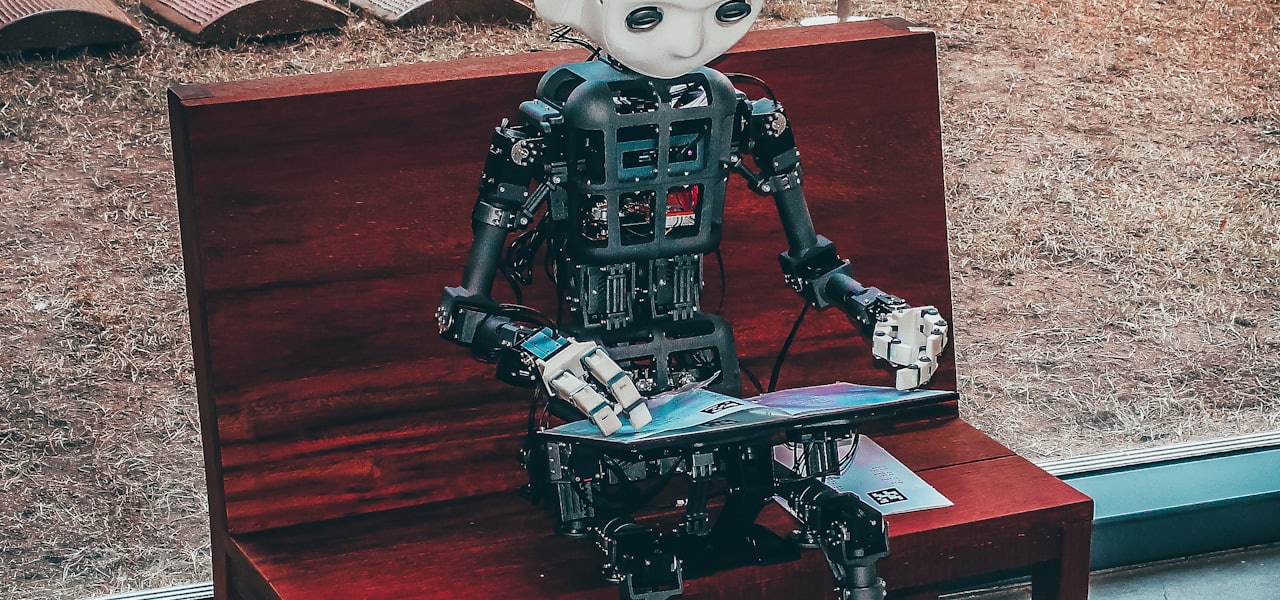
A Gödel machine is a hypothetical self-improving computer program that solves problems in an optimal way. It uses a recursive self-improvement protocol in which it rewrites its own code when it can prove the new code provides a better strategy. The machine was invented by Jürgen Schmidhuber (first proposed in 2003), but is named after Kurt Gödel who inspired the mathematical theories. The Gödel machine is often discussed when dealing with issues of meta-learning, also known as "learning to learn." Applications include automating human design decisions and transfer of knowledge between multiple related tasks, and may lead to design of more robust and general learning architectures. Though theoretically possible, no full implementation has been created. The Gödel machine is often compared with Marcus Hutter's AIXI, another formal specification for an artificial general intelligence. Schmidhuber points out that the Gödel machine could start out by implementing AIXItl as its initial sub-program, and self-modify after it finds proof that another algorithm for its search code will be better. == Limitations == Traditional problems solved by a computer only require one input and provide some output. Computers of this sort had their initial algorithm hardwired. This does not take into account the dynamic natural environment, and thus was a goal for the Gödel machine to overcome. The Gödel machine has limitations of its own, however. According to Gödel's First Incompleteness Theorem, any formal system that encompasses arithmetic is either flawed or allows for statements that cannot be proved in the system. Hence even a Gödel machine with unlimited computational resources must ignore those self-improvements whose effectiveness it cannot prove. == Variables of interest == There are three variables that are particularly useful in the run time of the Gödel machine. At some time t {\displaystyle t} , the variable time {\displaystyle {\text{time}}} will have the binary equivalent of t {\displaystyle t} . This is incremented steadily throughout the run time of the machine. Any input meant for the Gödel machine from the natural environment is stored in variable x {\displaystyle x} . It is likely the case that x {\displaystyle x} will hold different values for different values of variable time {\displaystyle {\text{time}}} . The outputs of the Gödel machine are stored in variable y {\displaystyle y} , where y ( t ) {\displaystyle y(t)} would be the output bit-string at some time t {\displaystyle t} . At any given time t {\displaystyle t} , where ( 1 ≤ t ≤ T ) {\displaystyle (1\leq t\leq T)} , the goal is to maximize future success or utility. A typical utility function follows the pattern u ( s , E n v ) : S × E → R {\displaystyle u(s,\mathrm {Env} ):S\times E\rightarrow \mathbb {R} } : u ( s , E n v ) = E μ [ ∑ τ = time T r ( τ ) ∣ s , E n v ] {\displaystyle u(s,\mathrm {Env} )=E_{\mu }{\Bigg [}\sum _{\tau ={\text{time}}}^{T}r(\tau )\mid s,\mathrm {Env} {\Bigg ]}} where r ( t ) {\displaystyle r(t)} is a real-valued reward input (encoded within s ( t ) {\displaystyle s(t)} ) at time t {\displaystyle t} , E μ [ ⋅ ∣ ⋅ ] {\displaystyle E_{\mu }[\cdot \mid \cdot ]} denotes the conditional expectation operator with respect to some possibly unknown distribution μ {\displaystyle \mu } from a set M {\displaystyle M} of possible distributions ( M {\displaystyle M} reflects whatever is known about the possibly probabilistic reactions of the environment), and the above-mentioned time = time ( s ) {\displaystyle {\text{time}}=\operatorname {time} (s)} is a function of state s {\displaystyle s} which uniquely identifies the current cycle. Note that we take into account the possibility of extending the expected lifespan through appropriate actions. == Instructions used by proof techniques == The nature of the six proof-modifying instructions below makes it impossible to insert an incorrect theorem into proof, thus trivializing proof verification. === get-axiom(n) === Appends the n-th axiom as a theorem to the current theorem sequence. Below is the initial axiom scheme: Hardware Axioms formally specify how components of the machine could change from one cycle to the next. Reward Axioms define the computational cost of hardware instruction and the physical cost of output actions. Related Axioms also define the lifetime of the Gödel machine as scalar quantities representing all rewards/costs. Environment Axioms restrict the way new inputs x are produced from the environment, based on previous sequences of inputs y. Uncertainty Axioms/String Manipulation Axioms are standard axioms for arithmetic, calculus, probability theory, and string manipulation that allow for the construction of proofs related to future variable values within the Gödel machine. Initial State Axioms contain information about how to reconstruct parts or all of the initial state. Utility Axioms describe the overall goal in the form of utility function u. === apply-rule(k, m, n) === Takes in the index k of an inference rule (such as Modus tollens, Modus ponens), and attempts to apply it to the two previously proved theorems m and n. The resulting theorem is then added to the proof. === delete-theorem(m) === Deletes the theorem stored at index m in the current proof. This helps to mitigate storage constraints caused by redundant and unnecessary theorems. Deleted theorems can no longer be referenced by the above apply-rule function. === set-switchprog(m, n) === Replaces switchprog S pm:n, provided it is a non-empty substring of S p. === check() === Verifies whether the goal of the proof search has been reached. A target theorem states that given the current axiomatized utility function u (Item 1f), the utility of a switch from p to the current switchprog would be higher than the utility of continuing the execution of p (which would keep searching for alternative switchprogs). === state2theorem(m, n) === Takes in two arguments, m and n, and attempts to convert the contents of Sm:n into a theorem. == Example applications == === Time-limited NP-hard optimization === The initial input to the Gödel machine is the representation of a connected graph with a large number of nodes linked by edges of various lengths. Within given time T it should find a cyclic path connecting all nodes. The only real-valued reward will occur at time T. It equals 1 divided by the length of the best path found so far (0 if none was found). There are no other inputs. The by-product of maximizing expected reward is to find the shortest path findable within the limited time, given the initial bias. === Fast theorem proving === Prove or disprove as quickly as possible that all even integers > 2 are the sum of two primes (Goldbach’s conjecture). The reward is 1/t, where t is the time required to produce and verify the first such proof. === Maximizing expected reward with bounded resources === A cognitive robot that needs at least 1 liter of gasoline per hour interacts with a partially unknown environment, trying to find hidden, limited gasoline depots to occasionally refuel its tank. It is rewarded in proportion to its lifetime, and dies after at most 100 years or as soon as its tank is empty or it falls off a cliff, and so on. The probabilistic environmental reactions are initially unknown but assumed to be sampled from the axiomatized Speed Prior, according to which hard-to-compute environmental reactions are unlikely. This permits a computable strategy for making near-optimal predictions. One by-product of maximizing expected reward is to maximize expected lifetime.
Apprenticeship learning
In artificial intelligence, apprenticeship learning (or learning from demonstration or imitation learning) is the process of learning by observing an expert. It can be viewed as a form of supervised learning, where the training dataset consists of task executions by a demonstration teacher. == Mapping function approach == Mapping methods try to mimic the expert by forming a direct mapping either from states to actions, or from states to reward values. For example, in 2002 researchers used such an approach to teach an AIBO robot basic soccer skills. === Inverse reinforcement learning approach === Inverse reinforcement learning (IRL) is the process of deriving a reward function from observed behavior. While ordinary "reinforcement learning" involves using rewards and punishments to learn behavior, in IRL the direction is reversed, and a robot observes a person's behavior to figure out what goal that behavior seems to be trying to achieve. The IRL problem can be defined as: Given 1) measurements of an agent's behaviour over time, in a variety of circumstances; 2) measurements of the sensory inputs to that agent; 3) a model of the physical environment (including the agent's body): Determine the reward function that the agent is optimizing. IRL researcher Stuart J. Russell proposes that IRL might be used to observe humans and attempt to codify their complex "ethical values", in an effort to create "ethical robots" that might someday know "not to cook your cat" without needing to be explicitly told. The scenario can be modeled as a "cooperative inverse reinforcement learning game", where a "person" player and a "robot" player cooperate to secure the person's implicit goals, despite these goals not being explicitly known by either the person nor the robot. In 2017, OpenAI and DeepMind applied deep learning to the cooperative inverse reinforcement learning in simple domains such as Atari games and straightforward robot tasks such as backflips. The human role was limited to answering queries from the robot as to which of two different actions were preferred. The researchers found evidence that the techniques may be economically scalable to modern systems. Apprenticeship via inverse reinforcement learning (AIRP) was developed by in 2004 Pieter Abbeel, Professor in Berkeley's EECS department, and Andrew Ng, Associate Professor in Stanford University's Computer Science Department. AIRP deals with "Markov decision process where we are not explicitly given a reward function, but where instead we can observe an expert demonstrating the task that we want to learn to perform". AIRP has been used to model reward functions of highly dynamic scenarios where there is no obvious reward function intuitively. Take the task of driving for example, there are many different objectives working simultaneously - such as maintaining safe following distance, a good speed, not changing lanes too often, etc. This task, may seem easy at first glance, but a trivial reward function may not converge to the policy wanted. One domain where AIRP has been used extensively is helicopter control. While simple trajectories can be intuitively derived, complicated tasks like aerobatics for shows has been successful. These include aerobatic maneuvers like - in-place flips, in-place rolls, loops, hurricanes and even auto-rotation landings. This work was developed by Pieter Abbeel, Adam Coates, and Andrew Ng - "Autonomous Helicopter Aerobatics through Apprenticeship Learning" === System model approach === System models try to mimic the expert by modeling world dynamics. == Plan approach == The system learns rules to associate preconditions and postconditions with each action. In one 1994 demonstration, a humanoid learns a generalized plan from only two demonstrations of a repetitive ball collection task. == Example == Learning from demonstration is often explained from a perspective that the working Robot-control-system is available and the human-demonstrator is using it. And indeed, if the software works, the Human operator takes the robot-arm, makes a move with it, and the robot will reproduce the action later. For example, he teaches the robot-arm how to put a cup under a coffeemaker and press the start-button. In the replay phase, the robot is imitating this behavior 1:1. But that is not how the system works internally; it is only what the audience can observe. In reality, Learning from demonstration is much more complex. One of the first works on learning by robot apprentices (anthropomorphic robots learning by imitation) was Adrian Stoica's PhD thesis in 1995. In 1997, robotics expert Stefan Schaal was working on the Sarcos robot-arm. The goal was simple: solve the pendulum swingup task. The robot itself can execute a movement, and as a result, the pendulum is moving. The problem is, that it is unclear what actions will result into which movement. It is an Optimal control-problem which can be described with mathematical formulas but is hard to solve. The idea from Schaal was, not to use a Brute-force solver but record the movements of a human-demonstration. The angle of the pendulum is logged over three seconds at the y-axis. This results into a diagram which produces a pattern. In computer animation, the principle is called spline animation. That means, on the x-axis the time is given, for example 0.5 seconds, 1.0 seconds, 1.5 seconds, while on the y-axis is the variable given. In most cases it's the position of an object. In the inverted pendulum it is the angle. The overall task consists of two parts: recording the angle over time and reproducing the recorded motion. The reproducing step is surprisingly simple. As an input we know, in which time step which angle the pendulum must have. Bringing the system to a state is called “Tracking control” or PID control. That means, we have a trajectory over time, and must find control actions to map the system to this trajectory. Other authors call the principle “steering behavior”, because the aim is to bring a robot to a given line.
Recursive neural network
A recursive neural network is a kind of deep neural network created by applying the same set of weights recursively over a structured input, to produce a structured prediction over variable-size input structures, or a scalar prediction on it, by traversing a given structure in topological order. These networks were first introduced to learn distributed representations of structure (such as logical terms), but have been successful in multiple applications, for instance in learning sequence and tree structures in natural language processing (mainly continuous representations of phrases and sentences based on word embeddings). == Architectures == === Basic === In the simplest architecture, nodes are combined into parents using a weight matrix (which is shared across the whole network) and a non-linearity such as the tanh {\displaystyle \tanh } hyperbolic function. If c 1 {\displaystyle c_{1}} and c 2 {\displaystyle c_{2}} are n {\displaystyle n} -dimensional vector representations of nodes, their parent will also be an n {\displaystyle n} -dimensional vector, defined as: p 1 , 2 = tanh ( W [ c 1 ; c 2 ] ) {\displaystyle p_{1,2}=\tanh(W[c_{1};c_{2}])} where W {\displaystyle W} is a learned n × 2 n {\displaystyle n\times 2n} weight matrix. This architecture, with a few improvements, has been used for successfully parsing natural scenes, syntactic parsing of natural language sentences, and recursive autoencoding and generative modeling of 3D shape structures in the form of cuboid abstractions. === Recursive cascade correlation (RecCC) === RecCC is a constructive neural network approach to deal with tree domains with pioneering applications to chemistry and extension to directed acyclic graphs. === Unsupervised RNN === A framework for unsupervised RNN has been introduced in 2004. === Tensor === Recursive neural tensor networks use a single tensor-based composition function for all nodes in the tree. == Training == === Stochastic gradient descent === Typically, stochastic gradient descent (SGD) is used to train the network. The gradient is computed using backpropagation through structure (BPTS), a variant of backpropagation through time used for recurrent neural networks. == Properties == The universal approximation capability of RNNs over trees has been proved in literature. == Related models == === Recurrent neural networks === Recurrent neural networks are recursive artificial neural networks with a certain structure: that of a linear chain. Whereas recursive neural networks operate on any hierarchical structure, combining child representations into parent representations, recurrent neural networks operate on the linear progression of time, combining the previous time step and a hidden representation into the representation for the current time step. === Tree Echo State Networks === An efficient approach to implement recursive neural networks is given by the Tree Echo State Network within the reservoir computing paradigm. === Extension to graphs === Extensions to graphs include graph neural network (GNN), Neural Network for Graphs (NN4G), and more recently convolutional neural networks for graphs.
One-shot learning (computer vision)
One-shot learning is an object categorization problem, found mostly in computer vision. Whereas most machine learning-based object categorization algorithms require training on hundreds or thousands of examples, one-shot learning aims to classify objects from one, or only a few, examples. The term few-shot learning is also used for these problems, especially when more than one example is needed. == Motivation == The ability to learn object categories from few examples, and at a rapid pace, has been demonstrated in humans. It is estimated that a child learns almost all of the 10 ~ 30 thousand object categories in the world by age six. This is due not only to the human mind's computational power, but also to its ability to synthesize and learn new object categories from existing information about different, previously learned categories. Given two examples from two object categories: one, an unknown object composed of familiar shapes, the second, an unknown, amorphous shape; it is much easier for humans to recognize the former than the latter, suggesting that humans make use of previously learned categories when learning new ones. The key motivation for solving one-shot learning is that systems, like humans, can use knowledge about object categories to classify new objects. == Background == As with most classification schemes, one-shot learning involves three main challenges: Representation: How should objects and categories be described? Learning: How can such descriptions be created? Recognition: How can a known object be filtered from enveloping clutter, irrespective of occlusion, viewpoint, and lighting? One-shot learning differs from single object recognition and standard category recognition algorithms in its emphasis on knowledge transfer, which makes use of previously learned categories. Model parameters: Reuses model parameters, based on the similarity between old and new categories. Categories are first learned on numerous training examples, then new categories are learned using transformations of model parameters from those initial categories or selecting relevant parameters for a classifier. Feature sharing: Shares parts or features of objects across categories. One algorithm extracts "diagnostic information" in patches from already learned categories by maximizing the patches' mutual information, and then applies these features to the learning of a new category. A dog category, for example, may be learned in one shot from previous knowledge of horse and cow categories, because dog objects may contain similar distinguishing patches. Contextual information: Appeals to global knowledge of the scene in which the object appears. Such global information can be used as frequency distributions in a conditional random field framework to recognize objects. Alternatively context can consider camera height and scene geometry. Algorithms of this type have two advantages. First, they learn object categories that are relatively dissimilar; and second, they perform well in ad hoc situations where an image has not been hand-cropped and aligned. == Theory == The Bayesian one-shot learning algorithm represents the foreground and background of images as parametrized by a mixture of constellation models. During the learning phase, the parameters of these models are learned using a conjugate density parameter posterior and variational Bayesian expectation–maximization (VBEM). In this stage the previously learned object categories inform the choice of model parameters via transfer by contextual information. For object recognition on new images, the posterior obtained during the learning phase is used in a Bayesian decision framework to estimate the ratio of p(object | test, train) to p(background clutter | test, train) where p is the probability of the outcome. === Bayesian framework === Given the task of finding a particular object in a query image, the overall objective of the Bayesian one-shot learning algorithm is to compare the probability that object is present vs the probability that only background clutter is present. If the former probability is higher, the algorithm reports the object's presence, otherwise the algorithm reports its absence. To compute these probabilities, the object class must be modeled from a set of (1 ~ 5) training images containing examples. To formalize these ideas, let I {\displaystyle I} be the query image, which contains either an example of the foreground category O f g {\displaystyle O_{fg}} or only background clutter of a generic background category O b g {\displaystyle O_{bg}} . Also let I t {\displaystyle I_{t}} be the set of training images used as the foreground category. The decision of whether I {\displaystyle I} contains an object from the foreground category, or only clutter from the background category is: R = p ( O f g | I , I t ) p ( O b g | I , I t ) = p ( I | I t , O f g ) p ( O f g ) p ( I | I t , O b g ) p ( O b g ) , {\displaystyle R={\frac {p(O_{fg}|I,I_{t})}{p(O_{bg}|I,I_{t})}}={\frac {p(I|I_{t},O_{fg})p(O_{fg})}{p(I|I_{t},O_{bg})p(O_{bg})}},} where the class posteriors p ( O f g | I , I t ) {\displaystyle p(O_{fg}|I,I_{t})} and p ( O b g | I , I t ) {\displaystyle p(O_{bg}|I,I_{t})} have been expanded by Bayes' theorem, yielding a ratio of likelihoods and a ratio of object category priors. We decide that the image I {\displaystyle I} contains an object from the foreground class if R {\displaystyle R} exceeds a certain threshold T {\displaystyle T} . We next introduce parametric models for the foreground and background categories with parameters θ {\displaystyle \theta } and θ b g {\displaystyle \theta _{bg}} respectively. This foreground parametric model is learned during the learning stage from I t {\displaystyle I_{t}} , as well as prior information of learned categories. The background model we assume to be uniform across images. Omitting the constant ratio of category priors, p ( O f g ) p ( O b g ) {\displaystyle {\frac {p(O_{fg})}{p(O_{bg})}}} , and parametrizing over θ {\displaystyle \theta } and θ b g {\displaystyle \theta _{bg}} yields R ∝ ∫ p ( I | θ , O f g ) p ( θ | I t , O f g ) d θ ∫ p ( I | θ b g , O b g ) p ( θ b g | I t , O b g ) d θ b g = ∫ p ( I | θ ) p ( θ | I t , O f g ) d θ ∫ p ( I | θ b g ) p ( θ b g | I t , O b g ) d θ b g {\displaystyle R\propto {\frac {\int {p(I|\theta ,O_{fg})p(\theta |I_{t},O_{fg})}d\theta }{\int {p(I|\theta _{bg},O_{bg})p(\theta _{bg}|I_{t},O_{bg})}d\theta _{bg}}}={\frac {\int {p(I|\theta )p(\theta |I_{t},O_{fg})}d\theta }{\int {p(I|\theta _{bg})p(\theta _{bg}|I_{t},O_{bg})}d\theta _{bg}}}} , having simplified p ( I | θ , O f g ) {\displaystyle p(I|\theta ,O_{fg})} and p ( I | θ , O b g ) {\displaystyle p(I|\theta ,O_{bg})} to p ( I | θ f g ) {\displaystyle p(I|\theta _{fg})} and p ( I | θ b g ) . {\displaystyle p(I|\theta _{bg}).} The posterior distribution of model parameters given the training images, p ( θ | I t , O f g ) {\displaystyle p(\theta |I_{t},O_{fg})} is estimated in the learning phase. In this estimation, one-shot learning differs sharply from more traditional Bayesian estimation models that approximate the integral as δ ( θ M L ) {\displaystyle \delta (\theta ^{ML})} . Instead, it uses a variational approach using prior information from previously learned categories. However, the traditional maximum likelihood estimation of the model parameters is used for the background model and the categories learned in advance through training. === Object category model === For each query image I {\displaystyle I} and training images I t {\displaystyle I_{t}} , a constellation model is used for representation. To obtain this model for a given image I {\displaystyle I} , first a set of N interesting regions is detected in the image using the Kadir–Brady saliency detector. Each region selected is represented by a location in the image, X i {\displaystyle X_{i}} and a description of its appearance, A i {\displaystyle A_{i}} . Letting X = ∑ i = 1 N X i , A = ∑ i = 1 N A i {\displaystyle X=\sum _{i=1}^{N}X_{i},A=\sum _{i=1}^{N}A_{i}} and X t {\displaystyle X_{t}} and A t {\displaystyle A_{t}} the analogous representations for training images, the expression for R becomes: R ∝ ∫ p ( X , A | θ , O f g ) p ( θ | X t , A t , O f g ) d θ ∫ p ( X , A | θ b g , O b g ) p ( θ b g | X t , A t , O b g ) d θ b g = ∫ p ( X , A | θ ) p ( θ | X t , A t , O f g ) d θ ∫ p ( X , A | θ b g ) p ( θ b g | X t , A t , O b g ) d θ b g {\displaystyle R\propto {\frac {\int {p(X,A|\theta ,O_{fg})p(\theta |X_{t},A_{t},O_{fg})}d\theta }{\int {p(X,A|\theta _{bg},O_{bg})p(\theta _{bg}|X_{t},A_{t},O_{bg})}d\theta _{bg}}}={\frac {\int {p(X,A|\theta )p(\theta |X_{t},A_{t},O_{fg})}d\theta }{\int {p(X,A|\theta _{bg})p(\theta _{bg}|X_{t},A_{t},O_{bg})}\,d\theta _{bg}}}} The likelihoods p ( X , A | θ ) {\displaystyle p(X,A|\theta )} and p ( X , A | θ b g ) {\displaystyle p(X,A|\theta _{bg})} are represented as mixtures of constellation models. A typical constellation model has
Variable kernel density estimation
In statistics, adaptive or "variable-bandwidth" kernel density estimation is a form of kernel density estimation in which the size of the kernels used in the estimate are varied depending upon either the location of the samples or the location of the test point. It is a particularly effective technique when the sample space is multi-dimensional. == Rationale == Given a set of samples, { x → i } {\displaystyle \lbrace {\vec {x}}_{i}\rbrace } , we wish to estimate the density, P ( x → ) {\displaystyle P({\vec {x}})} , at a test point, x → {\displaystyle {\vec {x}}} : P ( x → ) ≈ W n h D {\displaystyle P({\vec {x}})\approx {\frac {W}{nh^{D}}}} W = ∑ i = 1 n w i {\displaystyle W=\sum _{i=1}^{n}w_{i}} w i = K ( x → − x → i h ) {\displaystyle w_{i}=K\left({\frac {{\vec {x}}-{\vec {x}}_{i}}{h}}\right)} where n is the number of samples, K is the "kernel", h is its width and D is the number of dimensions in x → {\displaystyle {\vec {x}}} . The kernel can be thought of as a simple, linear filter. Using a fixed filter width may mean that in regions of low density, all samples will fall in the tails of the filter with very low weighting, while regions of high density will find an excessive number of samples in the central region with weighting close to unity. To fix this problem, we vary the width of the kernel in different regions of the sample space. There are two methods of doing this: balloon and pointwise estimation. In a balloon estimator, the kernel width is varied depending on the location of the test point. In a pointwise estimator, the kernel width is varied depending on the location of the sample. For multivariate estimators, the parameter, h, can be generalized to vary not just the size, but also the shape of the kernel. This more complicated approach will not be covered here. == Balloon estimators == A common method of varying the kernel width is to make it inversely proportional to the density at the test point: h = k [ n P ( x → ) ] 1 / D {\displaystyle h={\frac {k}{\left[nP({\vec {x}})\right]^{1/D}}}} where k is a constant. If we back-substitute the estimated PDF, and assuming a Gaussian kernel function, we can show that W is a constant: W = k D ( 2 π ) D / 2 {\displaystyle W=k^{D}(2\pi )^{D/2}} A similar derivation holds for any kernel whose normalising function is of the order hD, although with a different constant factor in place of the (2 π)D/2 term. This produces a generalization of the k-nearest neighbour algorithm. That is, a uniform kernel function will return the KNN technique. There are two components to the error: a variance term and a bias term. The variance term is given as: e 1 = P ∫ K 2 n h D {\displaystyle e_{1}={\frac {P\int K^{2}}{nh^{D}}}} . The bias term is found by evaluating the approximated function in the limit as the kernel width becomes much larger than the sample spacing. By using a Taylor expansion for the real function, the bias term drops out: e 2 = h 2 n ∇ 2 P {\displaystyle e_{2}={\frac {h^{2}}{n}}\nabla ^{2}P} An optimal kernel width that minimizes the error of each estimate can thus be derived. == Use for statistical classification == The method is particularly effective when applied to statistical classification. There are two ways we can proceed: the first is to compute the PDFs of each class separately, using different bandwidth parameters, and then compare them as in Taylor. Alternatively, we can divide up the sum based on the class of each sample: P ( j , x → ) ≈ 1 n ∑ i = 1 , c i = j n w i {\displaystyle P(j,{\vec {x}})\approx {\frac {1}{n}}\sum _{i=1,c_{i}=j}^{n}w_{i}} where ci is the class of the ith sample. The class of the test point may be estimated through maximum likelihood.
Graphics suite
A graphics suite is a software suite for graphics work that are distributed together. The programs are usually able to interact with each other on a higher level than the operating system would normally allow. There is no hard, fast rule regarding the programs to be included in a graphics application suite, but most will include at least a bitmap graphics editor and a vector graphics editor. In addition to these, the suite may contain VRML editors, animation editors, and morphing tools.
Spatial Analysis of Principal Components
Spatial Principal Component Analysis (sPCA) is a multivariate statistical technique that complements the traditional Principal Component Analysis (PCA) by incorporating spatial information into the analysis of genetic variation. While traditional PCA can be used to find spatial patterns, it focuses on reducing data dimensionality by identifying uncorrelated principal components that capture maximum variance, thus often lacking power to identify non-trivial spatial genetic patterns. By accounting for spatial autocorrelation, sPCA is able to uncover spatial patterns in the data and find the spatial structure of datasets where observations are either geographically or topologically linked. This statistical power improvement allows the investigation of cryptic spatial patterns of genetic variability otherwise overlooked. sPCA has been applied in various fields, including geography, ecology and genetics. == History == sPCA was introduced in 2008 by Thibaut Jombart, Sébastien Devillard, Anne-Béatrice Dufour, and D. Pontier as a spatially explicit method to investigate the spatial pattern of genetic variation among individuals or populations. In 2017, Valeria Montano and Thibaut Jombart published an alternative non-parametric test to evaluate the significance of global and local spatial genetic patterns with improved statistical power. == Details == sPCA modifies the PCA framework by integrating spatial weights, typically in the form of connectivity matrices or spatial adjacency graphs. It identifies principal components (PCs) that maximize both genentic variance and spatial autocorreation, as measured by Moran's I. These weights represent relationships between observations based on geographic distance or other spatial criteria. The method decomposes variance into two components: Global structures, correspond to positive autocorrelation, that is, reflect broad-scale spatial patterns where similar values cluster over large regions. Local structures, correspond to negative autocorrelation, that is, capture fine-scale spatial variations or localized patterns. The core of sPCA relies on the eigenanalysis of a spatially weighted covariance or correlation matrix. The spatial weight matrix can be constructed using techniques such as Delaunay triangulation, nearest-neighbor graphs, or distance-based criteria. Applications of sPCA should be used only as an explorative tool. == Applications == sPCA has been widely used in many fields, including: Ecology: To find spatial patterns in species distributions and environmental gradients. Genetics: Population structure and gene flow analysis while allowing for spatial autocorrelation considerations. Biogeography: To identify historical dispersal routes, and barriers to gene flow, providing insights into species distribution patterns and evolutionary history. == Software/Source Code == sPCA implementations are available in R in adegenet and ntbox . These tools facilitate the application of sPCA by providing functions for constructing spatial weight matrices, performing eigenanalysis, and obtaining spatial principal components in an easy-to-read form.